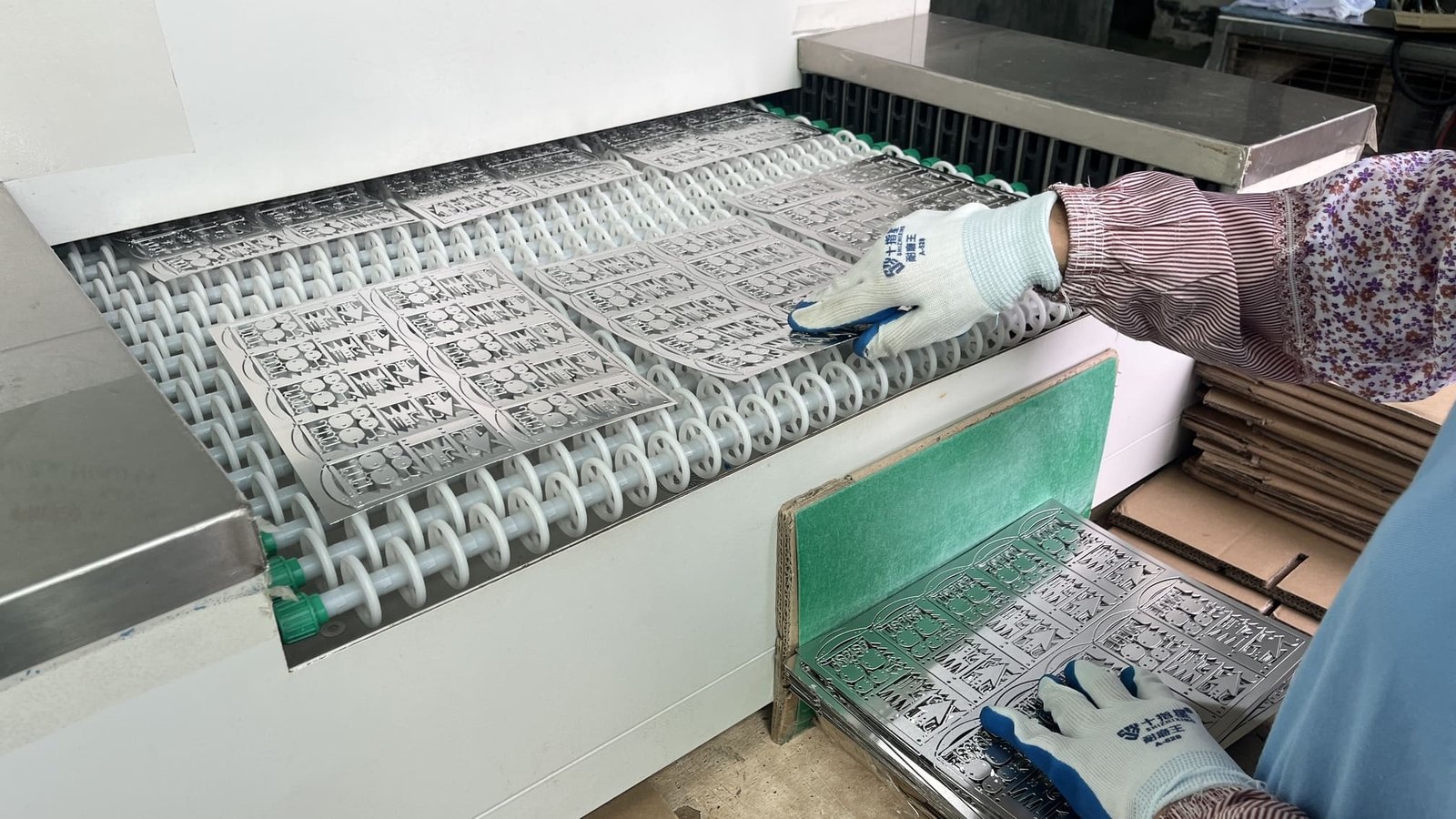
Metal etching is a subtractive manufacturing process that uses chemical etchants to selectively dissolve unmasked areas of sheet metal, producing burr-free, stress-free parts. It’s the process I reach for on thin-gauge precision work: meshes, lead frames, RF shields, encoder disks. Engineers spec it when a design has geometry too fussy for stamping tooling to be worth cutting, or features too fine for a laser to hold cleanly.
Metal Etching in One Paragraph
Metal etching, formally photochemical machining (PCM), removes material using corrosive chemistry rather than mechanical force or thermal energy. You laminate a light-sensitive photoresist onto a flat metal sheet, expose it to UV light through a phototool that carries the CAD geometry, then run the sheet through an etchant bath that eats away the unprotected metal. Because it’s pure chemical dissolution, the finished part carries no mechanically induced stress, no heat-affected zone, and no shear burr. That last part is what sells the process to most of my medical customers.
How the Photochemical Etching Process Actually Works
A production line runs the sheets through seven stages, in this order:
- Cleaning. Sheets pass through chemical degreasers to strip rolling oils and surface oxides. If you leave residual chromium oxide on stainless, the etchant won’t wet the surface properly and you get pitting or skipped features.
- Laminating. Dry-film photoresist is laminated to both sides of the sheet under heat and pressure.
- Exposure. The laminated sheet is clamped between two optical phototools that carry the CAD image. UV light cures the resist where you want metal to remain.
- Developing. A mild alkaline solution washes off the uncured resist, exposing bare metal in the areas you want to etch away.
- Etching. The sheet rides a conveyor through a spray chamber. Heated etchant — usually 40 to 50°C — sprays from top and bottom simultaneously.
- Stripping. A hot alkaline stripper pulls the cured photoresist off the finished part.
- Inspection. AOI (automated optical inspection) checks dimensions against the CAD file.
The spray step is where most of the actual process control lives. Nozzle wear, bath concentration, conveyor speed, temperature — all of it moves your etch rate around, and if you’re not compensating, your tolerances drift by shift.
What Metals Can Be Etched (And Which Can’t)
Most commercial sheet metals accept chemical etching, but the etchant chemistry changes with the alloy. Standard ferric chloride handles iron- and copper-based alloys, which covers maybe 80% of the work that walks through a typical shop’s door. Gold and platinum shrug it off; those want plasma etching or another route entirely.
| Metal | Etchant Chemistry | Typical Thickness Range | Notes |
|---|---|---|---|
| Stainless Steel (300/400 series) | Ferric Chloride (FeCl3) | 0.01mm – 2.0mm | Industry workhorse. Best edge quality of anything on this list. |
| Copper & Brass | Ferric or Cupric Chloride | 0.01mm – 1.5mm | Etches fast, which is a mixed blessing — timing control matters. |
| Aluminum | Sodium Hydroxide (alkaline) | 0.05mm – 2.0mm | Reactive. Needs dedicated extraction. Not every shop runs it. |
| Titanium | Hydrofluoric acid blends | 0.025mm – 1.0mm | HF is nasty. Specialist shops only. |
| Molybdenum | Nitric/Sulfuric acid blends | 0.025mm – 0.5mm | Expensive base material. Shows up in medical. |
| Nickel Alloys (Invar, Kovar) | Ferric Chloride | 0.01mm – 1.5mm | Thermal expansion matching for electronics packaging. |
If your part is titanium, get a quote from three shops. You’ll see the price spread and figure out quickly who actually runs it in-house versus who’s job-shopping it out.
Etch Factor, Undercut, and Design Tolerances
Liquid etchant dissolves metal isotropically. It works laterally under the edge of the photoresist at roughly the same time it’s cutting downward, and that sideways loss under the mask is the undercut. You cannot design it away. You compensate for it.
The way shops measure this is with the Etch Factor:
Etch Factor = Etch Depth ÷ Undercut
A standard precision etch factor is 3:1. Three units down for every one unit sideways under the mask. To land the drawing dimension, CAD applies a compensation on the phototool — if you want a 1.000″ hole in 0.010″ stock, the phototool gets drawn at roughly 0.995″ so the lateral loss brings you back to nominal.
Tolerances scale with material thickness. The rule of thumb is ±10% of thickness. So 0.2mm stock gets you ±0.02mm, and 0.5mm stock gets you ±0.05mm, and if you spec ±0.01mm on 0.5mm material you’re going to get a phone call from your vendor. Minimum feature widths — slots, mesh openings, whatever — need to run at least 100 to 110% of material thickness. Fluid has to get in and out of the feature, and if the opening is narrower than the sheet is thick, etchant exchange stalls and the geometry falls apart.
Metal Etching vs. Laser Cutting vs. Stamping vs. CNC
The choice comes down to thickness, volume, and how much you care about the edge condition.
| Process | Typical Tolerance | Tooling Cost | Min Feature Size | Material Stress |
|---|---|---|---|---|
| Metal Etching | ±10% of thickness | ~$120 (phototool) | 1× thickness | None |
| Fiber Laser | ±0.05 to ±0.1mm | Zero | ~0.2mm | Thermal (HAZ) |
| Stamping | ±0.02mm | $5,000 – $50,000+ | ~1.5× thickness | High mechanical |
| CNC Milling | ±0.025mm | $0 – $300 (fixturing) | Depends on tool | Low mechanical |
When to choose etching. The classic case is complex patterns in thin material. A 10,000-hole filter mesh in 0.5mm stainless — a laser has to cut every one of those holes point by point, and the machine-hour cost adds up. Etching dissolves all 10,000 holes in the same bath pass. It also wins for prototyping. A phototool costs about $120 and you can have one in hand inside an hour, versus weeks and thousands of dollars to cut a hard steel stamping die.
When to choose laser or CNC. Modern fiber lasers hold ISO 2768-1 m class, roughly ±0.1 to ±0.2mm, and they handle heavy plate that etching physically can’t touch. If the design has minimal internal geometry — think outer-profile brackets — laser will beat etching on piece price.
The one everybody forgets: stamping. If your volume is high enough (six figures annually, generally) and the geometry is stamping-friendly, the tooling amortizes and stamping crushes both on per-part cost. It just doesn’t work for the burr-sensitive stuff.
Real Applications Across Industries
- Aerospace and defense: encoder disks, radar shielding, structural shims that need to lie perfectly flat.
- Medical: surgical blades, titanium bone saws, Nitinol stents. Etching holds dimensions to around ±0.0002 inches on critical features without touching the metallurgy of the material. That last point is why the industry uses it — a stamped stent has work-hardened edges that behave differently in service.
- Electronics: copper lead frames, EMI/RFI shielding cans, fine-pitch contacts.
- Energy: bipolar plates for hydrogen fuel cells. Micro-fluidic channels around 325 µm deep etched into 400 µm stainless without warping the sheet.
- Industrial: extruder screens, filtration meshes.
Bipolar plates are the interesting one right now. Every fuel-cell program I’ve looked at in the last two years is running etched plates, because the alternative is stamping features that fine into thin stainless and getting fatigue cracking down the road.
Cost, Lead Time, and Sourcing Reality
Etching pricing runs on a cost-per-sheet model. The labor to clean, laminate, expose, and develop a 12″ × 18″ sheet is basically fixed regardless of what’s on it. If you nest 50 parts on the sheet, the labor divides by 50. If you nest 5,000 micro-components, labor drops to a fraction of a cent per part. This is why the process rewards good panelization work at the quote stage, and why a shop that isn’t paying attention to nesting is quietly overcharging you.
Material sets the floor on price. Aluminum or mild steel runs $5 to $10 per pound. Specialty stuff — 0.0005″ stainless foil, molybdenum sheet — runs a couple orders of magnitude higher, and molybdenum in particular is worth calling your metals broker about because the spot price moves. Lead times are typically 1 to 3 weeks for production; prototype turns in 24 to 48 hours from shops that actively market that service.
When NOT to use etching. Above about 2.0mm (0.080″), the process falls apart. The dwell time needed to etch through thick plate produces so much undercut that your edge bevel becomes unpredictable — trapezoidal cross-sections that don’t hold dimensional intent, walls that lean, edge geometry that changes shift to shift. Send thick plate to a laser or a waterjet.
Environmental and Safety Considerations
Commercial PCM operates under fairly tight environmental rules for heavy metal disposal, and rightly so. Spent ferric chloride ends up loaded with dissolved metals from whatever you’ve been etching. Dumping it untreated puts copper hydroxide precipitates and heavy metals into the municipal water system, which is both illegal and, frankly, the reason a lot of the smaller shops disappeared during the 2000s.
Modern shops run closed-loop regeneration. Sensors watch the etchant concentration, and when iron and heavy metal saturation crosses a threshold, the system injects muriatic acid and chlorine gas to regenerate the ferric chloride back to active form. Extends bath life by weeks and cuts hazardous waste volume dramatically.
REACH and RoHS3 add a second layer. Vendors have to document that trace chemicals from strippers and surfactants are fully rinsed off the finished parts, so no SVHCs go out the door with the shipment. Most established shops have this dialed in and can hand you the compliance paperwork with the parts.
FAQs
Is metal etching the same as engraving?
No. Engraving uses a laser or a rotating cutter to shave a shallow groove into the surface of a part. Etching is chemical, and it either creates a partial-depth channel (half-etching) or cuts all the way through the sheet.
How thin can you etch metal?
Down to about 0.0005 inches — 0.0127mm — which is basically foil. Counterintuitively, extremely thin stock gets you the tightest tolerances, because the etchant clears the metal before there’s time for meaningful undercut to develop. This is why a lot of the microelectronic packaging work lives at the very thin end of the range: it’s not that thin is easier to make, it’s that thin is more predictable once you’re set up for it, and the aspect ratios stay in your favor. If you’re speccing dimensional tolerances on foil-gauge material, ask the shop for their SPC data on the specific alloy before you finalize the drawing.
How much does metal etching cost per part?
Depends entirely on how many parts fit on a sheet. A one-inch component in 0.010″ stock might land around $0.59 each at 500 pieces and drop below $0.20 at 50,000, as the fixed sheet labor amortizes across more nested parts.
Can you etch metal at home?
Yes.
Copper, brass, and mild steel etch fine at home with ferric chloride or copper sulfate. Do it outside — the vapors will rust every tool in a closed garage inside a month, and you don’t want to be breathing them regardless. Don’t pour spent etchant down the drain. It’s loaded with dissolved metal. Neutralize it with baking soda and treat what’s left as chemical waste.