TL;DR: A reliable Chinese metal etching supplier is a factory (not a trader) that can prove ±0.01 mm line width tolerance, is transparent about phototool costs (usually under $120), quotes realistic 10–15 day sample lead times, and holds a verifiable ISO 9001 with material traceability. Below is the 5-step vetting sequence I actually use.
The Real Reason Most Buyers Get Burned (It’s Not Price)
The global precision metal parts market hit $18.4 billion in 2025, and a big chunk of it flows through platforms like Alibaba. Most buyers I talk to assume they’re speaking with a manufacturer. Often they aren’t. They’re speaking with a trading company that has never touched an etchant tank.
The primary risk in photochemical machining isn’t fraud in the dramatic sense. It’s the invisible middleman. Traders subcontract your order to whichever workshop is cheapest that week. That breaks process consistency. Etchant chemistry, spray pressure, bath temperature — these variables have to sit inside a narrow window to hold tight tolerances across batches. A trader swapping workshops between your sample run and your production run wipes out every capability test you did on the initial parts. You’re essentially starting over without knowing it.
| Feature | Real Factory | Trading Company | Broker |
|---|---|---|---|
| Process Control | High (controls chemistry & spray variables) | Zero | Zero |
| Lead Time | Predictable (10–15 days for samples) | Unpredictable (adds 3–7 days) | Highly variable |
| Price Transparency | Separates phototool and piece costs | Bundles costs to hide margins | Commission-based |
| QC Accountability | Direct line to engineering team | Deflects technical questions | Disappears post-payment |
Five Signals That Separate a Real Etching Factory from a Trader
Five signals actually work. Video evidence of equipment, specific technical responses under pressure, consistent staffing across calls, a registered address that matches, and dedicated facilities for the ugly parts of the process.
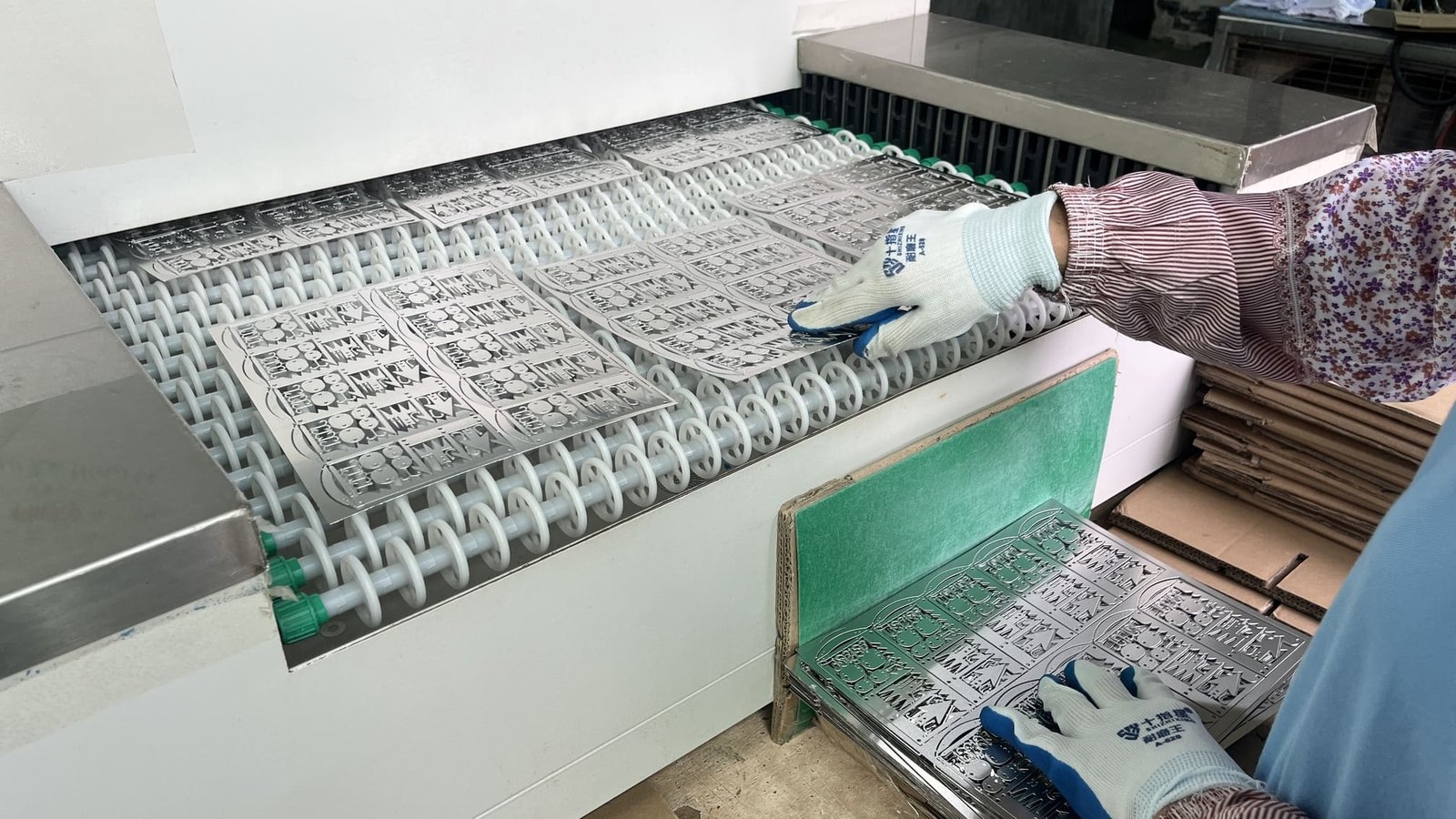
- Spray etcher visibility. A factory video walkthrough should show industrial conveyorized chemical etchers. Brands like Beijing Golden Eagle or Chemcut turn up on the equipment plates. Traders show clean meeting rooms, assembly benches, or generic warehouse racks stacked with boxes that could contain literally anything.
- DFM responsiveness. Ask their engineering contact: “What’s your etch factor for 0.2 mm SS304?” A real factory gives you a number immediately — usually somewhere in the 1.5 to 2.0 range. A trader says “we’ll check with the engineers and get back to you.” That answer alone tells you what you need to know.
- Personnel consistency. The engineers and account managers on your first two video calls should still be there on call number five. Rotating faces means a trader is scrambling to find whoever’s free and speaks passable English that day.
- License verification. The address on the Alibaba profile has to match the Chinese business license character for character. Any deviation, ask.
- Facility type. Photochemical etching needs environmental controls, wastewater treatment, and yellow-light darkrooms for photoresist exposure. If the video tour doesn’t casually pan across at least one of these, they’re sending your work out the back door.
Capability Audit — What to Actually Ask For (With Numbers)
A capability audit should verify four numeric specs: minimum line width, half-etch depth tolerance, maximum panel size, and material-specific etch factor. Marketing brochures are useless here. Ask for the actual capability matrix, the one they send to their automotive customers.
Top-tier Chinese manufacturers publish precise limitations, and the good ones don’t oversell. Shenzhen Zhuolida, a Guangdong-based factory that a lot of Western semiconductor buyers use, processes material thicknesses from 0.03 mm to 2.0 mm. Their line width and spacing control sits between 0.01 mm and 0.1 mm, general dimensional tolerance ±0.01 mm. For semiconductor lead frames specifically, they advertise tolerances down to ±0.003 mm, though anecdotally you should expect the real production window to sit a hair wider than the marketing number on any factory’s spec sheet.
| Capability Metric | Mid-Tier Factory (Standard) | Top-Tier Factory (Precision) |
|---|---|---|
| Standard Tolerance | ±15% of material thickness | ±10% of material thickness |
| Min. Line Width | 0.10 mm | 0.01 mm |
| Thickness Range | 0.1 mm – 1.0 mm | 0.03 mm – 2.0 mm |
| Half-Etch Depth | ±0.025 mm | ±0.010 mm |
Ask for inspection reports on parts they’ve etched in the last 90 days in your target material — C1100 copper, SS316, whatever you’re specifying. If they can’t produce recent reports on your specific material, that tells you they haven’t run it recently, which tells you their process for it isn’t dialed in.
Certifications That Matter vs. Certifications That Are Theater
ISO 9001 is baseline. It’s also the most rented and forged document in the industry. Don’t accept a PDF at face value.
Plug the certificate number into IAF CertSearch (iafcertsearch.org). If it doesn’t appear, or the certification body isn’t accredited, walk. You can also cross-reference through the CNCA — the Certification and Accreditation Administration of China — as a second check.
The scope text on the certificate matters more than the certificate itself. A scope reading “design and manufacture of precision metal components” confirms factory status. A scope restricted to “sales and distribution of hardware” is a trader outing themselves in writing. Buyers skip this. Read the scope.
Other certifications map to specific industries:
- IATF 16949 for automotive.
- AS9100 for aerospace.
- RoHS and REACH — ask for SGS or TÜV reports on the actual finished parts, not just the raw material declarations from their coil supplier.
The Sample Order Trap (And How to Design One That Actually Tests the Factory)
Standard sample orders don’t predict production quality, because factories cherry-pick the best units out of a diagnostic run and hand-finish them to your drawing. It’s not really cheating, it’s just the way the industry works. Everyone does it. Your job is to design a sample that can’t be cherry-picked out of trouble.
Photo etching is cheap to prototype, which is the one thing working in your favor. Digital phototools run under $120 and factories generate them in under an hour. Because tooling is that cheap, there’s no reason not to design a diagnostic part specifically for vetting rather than sending your real drawing on the first pass.
Four features to include:
- A tight inner-diameter to outer-diameter ratio.
- Mixed feature sizes on the same panel — largest and smallest geometries sitting right next to each other. This is the one that catches most workshops.
- A high aspect ratio slot.
- At least one half-etch feature. Blind depth control across a sheet is the hardest variable to hold, and it’s where cheap chemistry shows up first.
Order 100 units. Measure unit 1, unit 50, and unit 100. The variance is your real Cpk, not the number they’ll quote you when you ask.
Realistic Price Benchmarks for 2025 (So You Can Spot Lowball Bait)
Lowball pricing is the tactic traders use to lock you in with a deposit, then hit you with setup fees, material surcharges, and “unforeseen” tooling costs later. Knowing the floors protects you.
For custom 0.03 mm stainless steel precision components, 2025/2026 factory pricing lands in the $0.05 to $0.50 per piece range at 500-unit MOQ. That’s a wide band because area and feature density swing it hard, and factories won’t quote you an area-based $/dm² number reliably without a CAD file — I’ve asked, they’ll always want the geometry first. For architectural work, 4×8 ft etched stainless elevator door panels sit around $60 to $80 per sheet.
Phototool costs should stay under $120 for standard tolerances. If a supplier quotes zero tooling but the piece price is double what you’d expect, they’re just burying the tooling in the piece cost. If a supplier quotes $0.01 per piece for a complex 0.5 mm SS316 part, they are either a trader setting up a bait-and-switch or a workshop planning to cut corners on chemistry that will not survive a REACH audit.
Secondary Processes — Where Quiet Outsourcing Kills Lead Times
A lot of etching factories quietly farm out secondary operations. Plating (nickel, gold, tin), bending, PSA lamination. This tacks 5 to 10 days onto your lead time and drops an unverified third party into your QC chain without telling you.
Guangdong is dense with plating clusters, which is both the reason outsourcing is so easy and the reason it’s so hard to trace. Comprehensive factories like Dongguan-based TMNetch keep laser cutting, bending, and plating in-house, but plenty of smaller etching shops truck their flat parts to specialized plating facilities in Sanchong Industrial Park or similar zones nearby and quote you a lead time that assumes everything’s on-site.
Get an explicit breakdown of which processes they own. If they outsource plating or laser welding, make them name the subcontractor in writing. In-house wins on tolerance, turnaround, and accountability when something goes wrong at 2 AM your time.
Payment Terms, IP Protection, and the Contract Clauses Most Buyers Skip
Don’t assume Alibaba Trade Assurance will bail you out if parts fall out of tolerance. In August 2026, a buyer publicly reported ordering custom 2mm fabricated aluminum parts and receiving what amounted to random scrap. Trade Assurance offered a partial refund of $3,953 rather than a full return. Trade Assurance is built around shipment confirmation, not dimensional accuracy. That’s not going to change.
Protect yourself in writing:
- Payment structure. Never 100% T/T in advance. Standard is 30% deposit and 70% before shipment, after video inspection or third-party QC clears.
- AQL. Define an Acceptable Quality Limit of 2.5 for major defects in the PO.
- Tooling ownership. State explicitly that you own the digital phototool once you’ve paid for it.
- IP. Western NDAs are worthless in a Chinese court. Use an NNN agreement — Non-Disclosure, Non-Use, Non-Circumvention — drafted under PRC law. If your supplier balks at signing an NNN, you have your answer.
A 5-Step Vetting Workflow You Can Execute in Two Weeks
The exact sequence:
- Shortlist 5–7 candidates. Filter Alibaba and direct search results for ISO 9001 manufacturers whose media actually shows physical spray etchers, not renderings.
- Request documentation. Capability matrix, IAF-verifiable ISO certificate, and a video walkthrough that includes the wastewater treatment area.
- Run DFM review. Send them your diagnostic sample drawing. Time how fast their engineers flag the half-etch depth tolerance challenges. Under an hour is good. A day is fine. A week means they’re outsourcing the engineering review too.
- Order diagnostic samples. Pay the ~$120 phototool fee and order 100 units from your top two.
- Measure and award. Run the samples through your CMM or optical comparator. Award to whoever has the lowest batch variance, not the lowest per-piece price.
FAQ
How do I verify a Chinese metal etching factory isn’t just a trading company?
A real factory will give you a live video walkthrough of their production floor on request, and you’ll see conveyorized spray etchers and yellow-light darkrooms in the shot. Their Alibaba registered address will match their Chinese business license exactly, and their ISO 9001 scope will say “manufacturing,” not “sales.”
What tolerances can I realistically expect from a Chinese photochemical etching supplier?
Top-tier factories hold general tolerances of ±0.01 mm for materials up to 1.0 mm thick. For semiconductor lead frames, some can push down to ±0.003 mm, though you should treat that number as a best-case marketing figure and expect real production to sit a bit wider. Mid-tier shops typically hold ±15% of material thickness, which is fine for most industrial parts and a disaster for anything precision.
What’s a fair price per part for photochemical etching from China in 2025?
It varies by area, thickness, material, and feature density. For standard 0.03 mm stainless steel precision parts, $0.05 to $0.50 per piece at a 500-unit MOQ is the honest band. Phototool setup should be under $120.
Is Alibaba Trade Assurance actually useful if my etched parts are out of tolerance?
It’s decent at preventing non-shipment fraud. It’s poor at dimensional tolerance disputes — buyers reporting partial refunds on custom parts that missed spec is a recurring pattern. Third-party pre-shipment inspection protects you better than platform mediation.